Cadence: FigBuild 2026 Entry
Industry
UX/UI Design
Date
February 2026
FigBuild 2026 was an online hackathon hosted by Figma. I created this project in a team of two, and I served as the lead designer and researcher. The timeline for this project was 3 days.
The Problem
Chronic stress is increasing in humans around the globe. According to “Wellbeing, Space and Society,” there is “an alarming increase in stress globally.” Stress is an intangible part of the human experience, and many people don’t realize they’re experiencing it until it has already started taking a toll. These prolonged levels of stress can worsen existing health conditions, including digestive issues, autoimmune diseases, and neurological disorders. From personal experiences, we understand how frustrating it can be to have a doctor tell you your condition is worsened by stress, and not to have a way to quantify stress. But how can we track and quantify stress if most people don’t even know that they are stressed?
The Solution
Well, we have the answer. Meet Cadence.
Cadence is a comprehensive application where users can track stress, health symptoms, and receive real-time advice from the built-in AI.
What Makes Cadence Different?
There are tons of different fitness and wellness apps, so what makes Cadence different?
Well, Cadence will utilize a new speculative technology: Cadence Patch
This patch will track in real time cortisol levels, blood pressure, vitamin levels, and muscle tension. All of these new metrics and more traditional ones, such as heart rate, location, and sound levels, will be interpreted by the built-in AI to provide the users with real relief from stress.

Meet Our Users
Though Cadence could be utilized by a vast majority of people, we have chosen to focus on users with chronic health conditions. We feel that this is an often-overlooked population, especially those with invisible health conditions.
Keeping this in mind, we designed Cadence to target users aged 18-35 with one or more health conditions that are worsened by stress. We want to help users understand what triggers their stress, how their stress relates to their medical symptoms, and what simple solutions can be implemented to help users get relief.
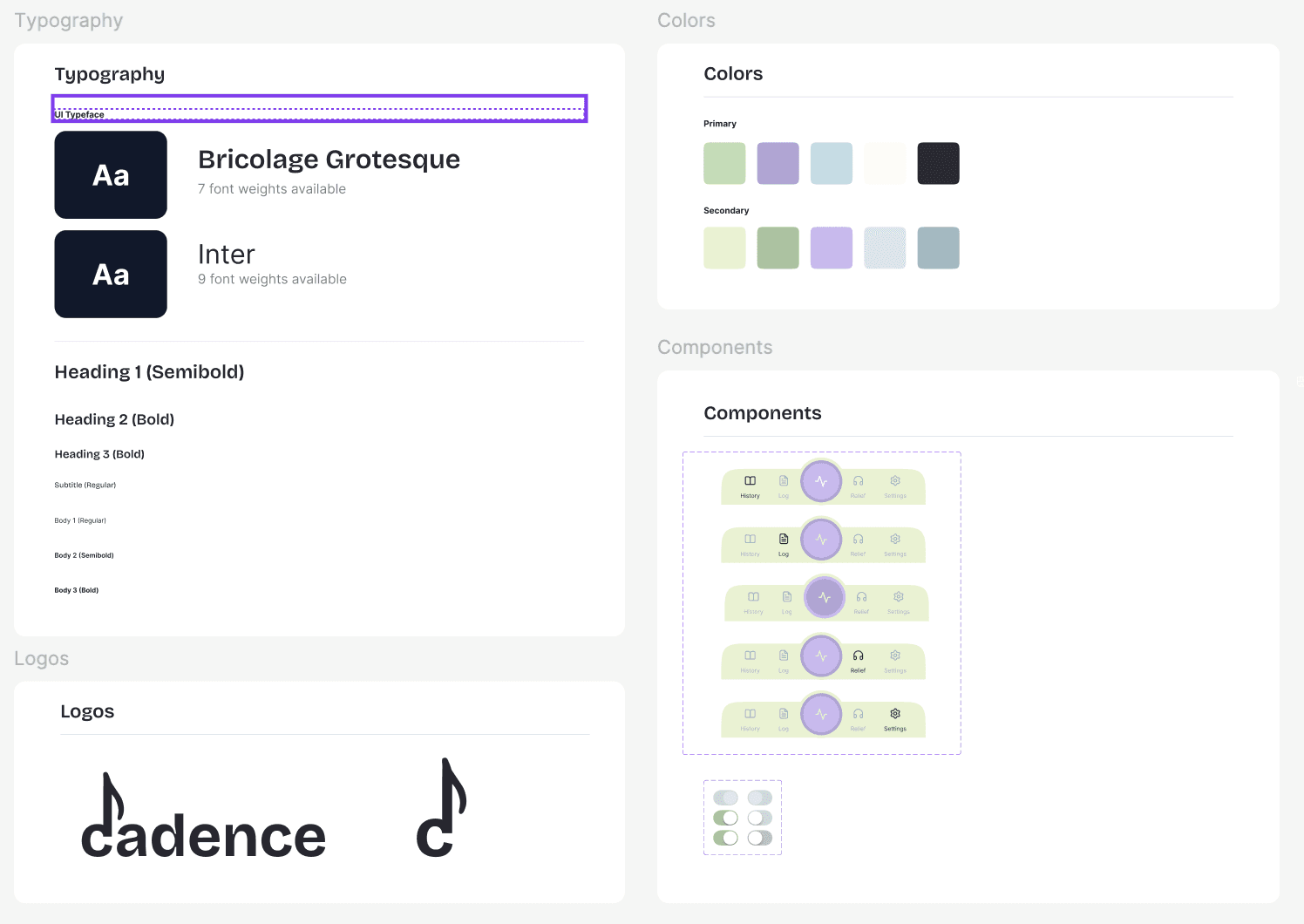
Design System
User Flow
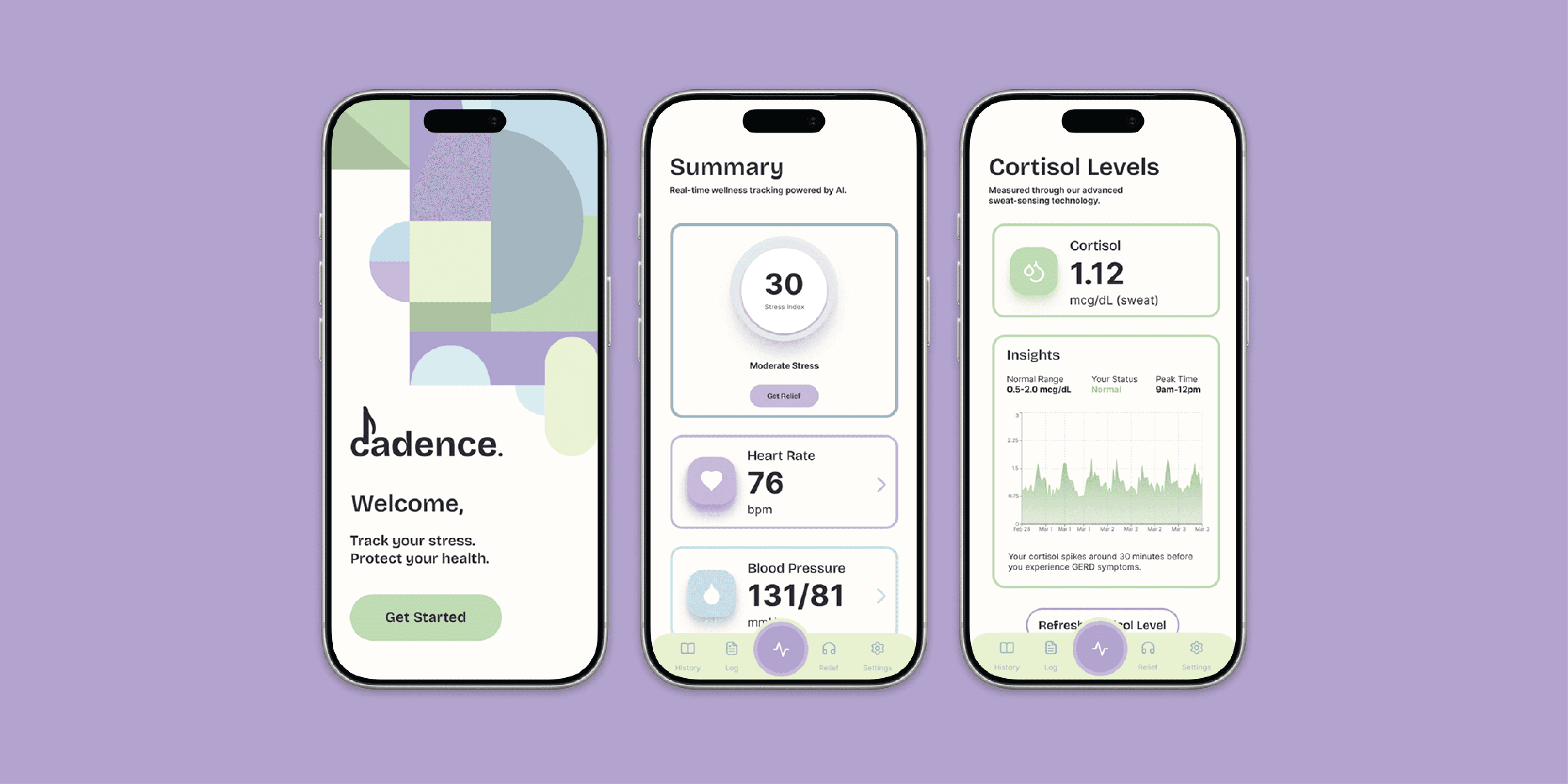
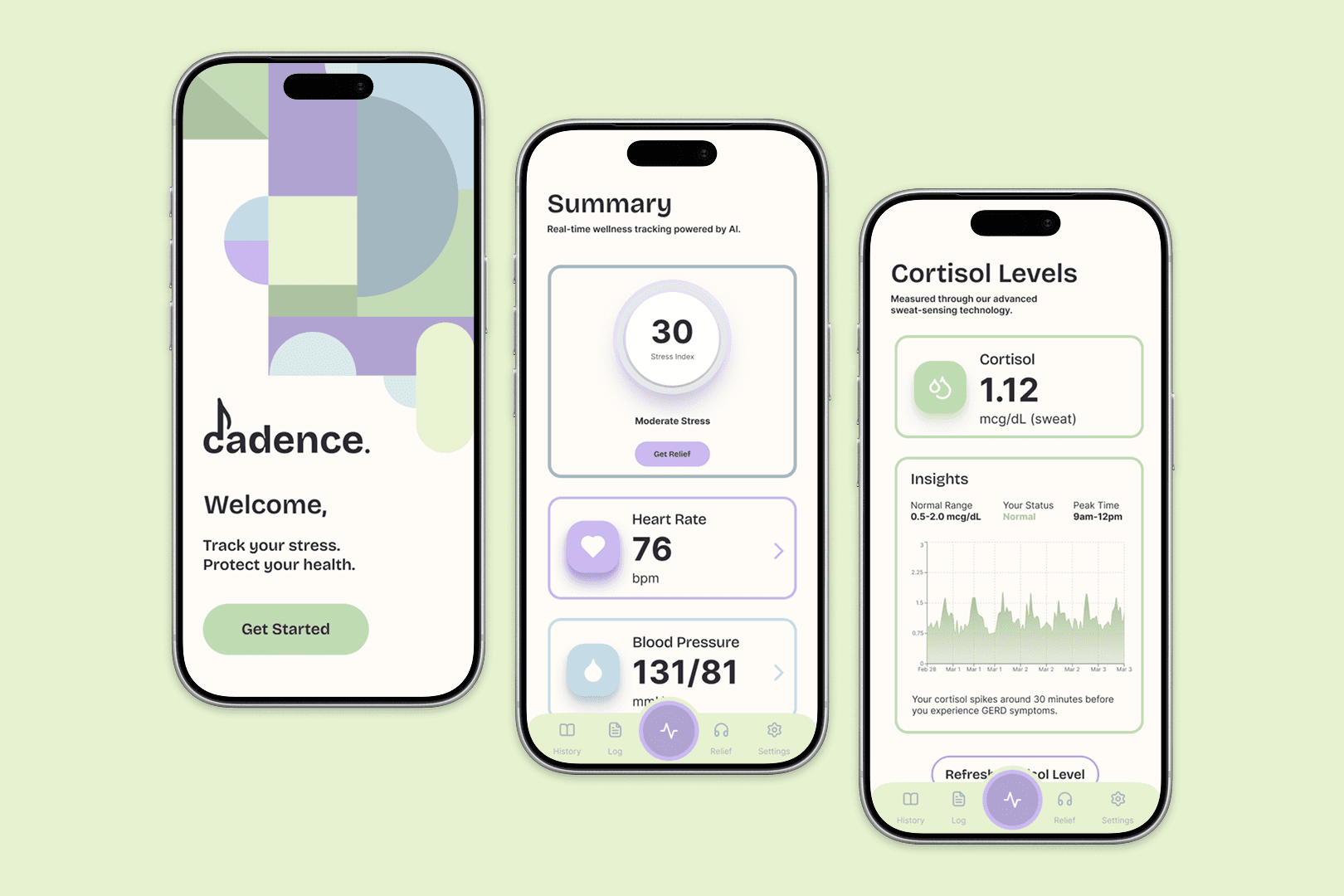
We wanted Cadence to have a simple, yet effective user flow. The first screens welcome the user and allow the user to explore a summary of each of the metrics that Cadence is tracking. Clicking on one of the metrics will take the user into a more detailed view.
The Summary page features a “Stress Index,” which is a measurement of stress generated by Cadence AI.
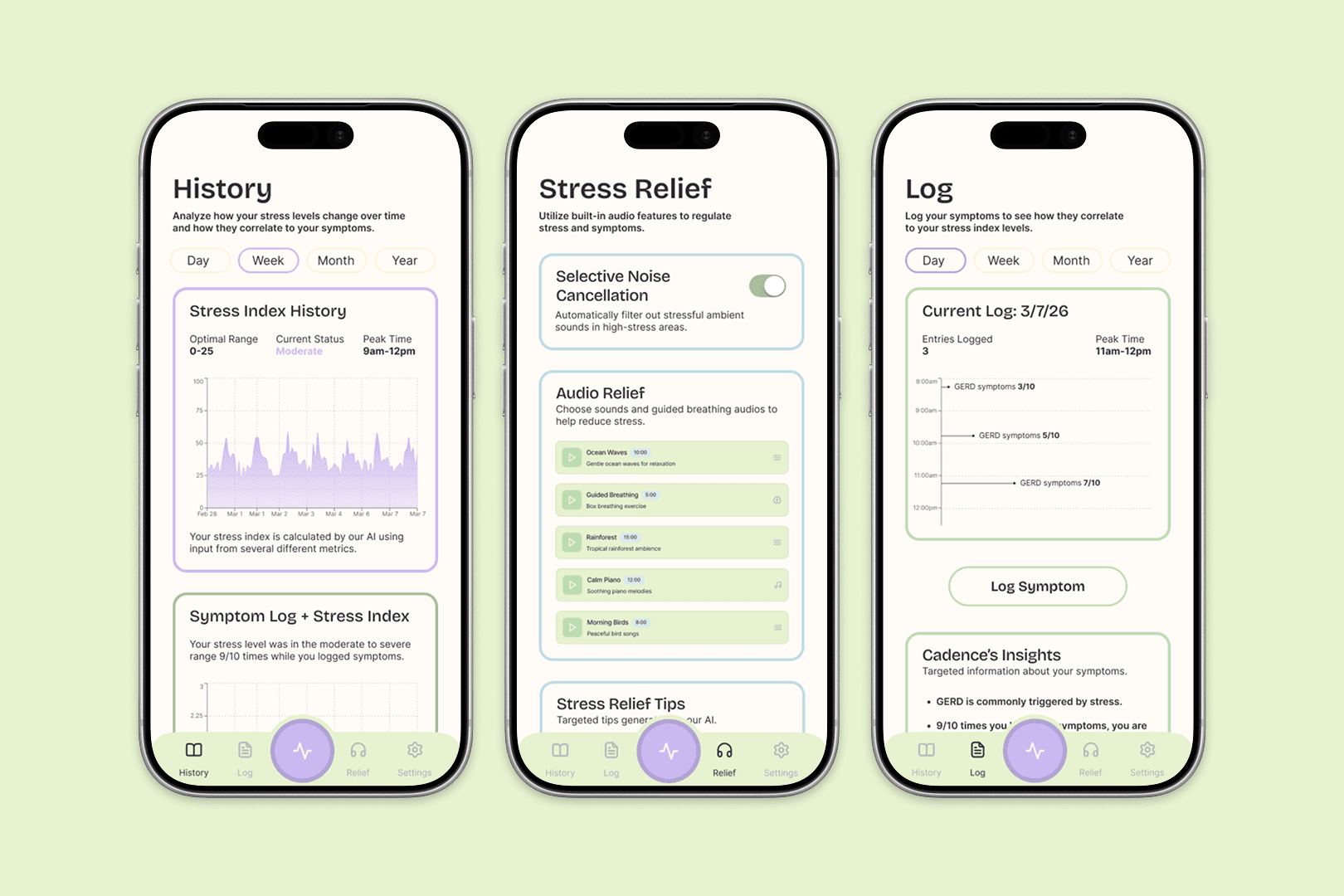
The History page breaks down each tracked metric over a certain period of time and explains how each metric personally affects the user’s stress index score.
The Log page allows the user to input what health symptoms they experience throughout the day. Cadence AI then provides insights on how these symptoms correlate to stress levels.
The Stress Relief page provides different features that the user can use to reduce stress levels.
Use Case 1
Use: Managing Stress to ease Gastroesophageal reflux disease (GERD)
Actor: A user suffering from GERD, whose doctor has told them is triggered by stress.
Scenario: User allows Cadence AI to track metrics through fitness wearables, Cadence Patch, smartphone, and active noise cancellation headphones/earbuds. User logs GERD symptoms as they occur and rates them accurately. Cadence AI analyzes how GERD symptoms correlate to measured metrics. Cadence AI accurately determines that GERD occurs more frequently when cortisol levels are raised, when the user is at school, and when muscle tension is extremely elevated. Cadence AI sends the user notifications at times when GERD symptoms and stress levels tend to be the worst, which provide the user with auditory sensory experiences and suggestions to relax muscles to help alleviate stress. Users are more aware of when they are experiencing stress and are able to manage their stress level, in turn reducing their GERD symptoms.
Use Case 2
Use: Becoming more aware of when you are stressed.
Actor: User that doesn’t think that they experience extreme stress.
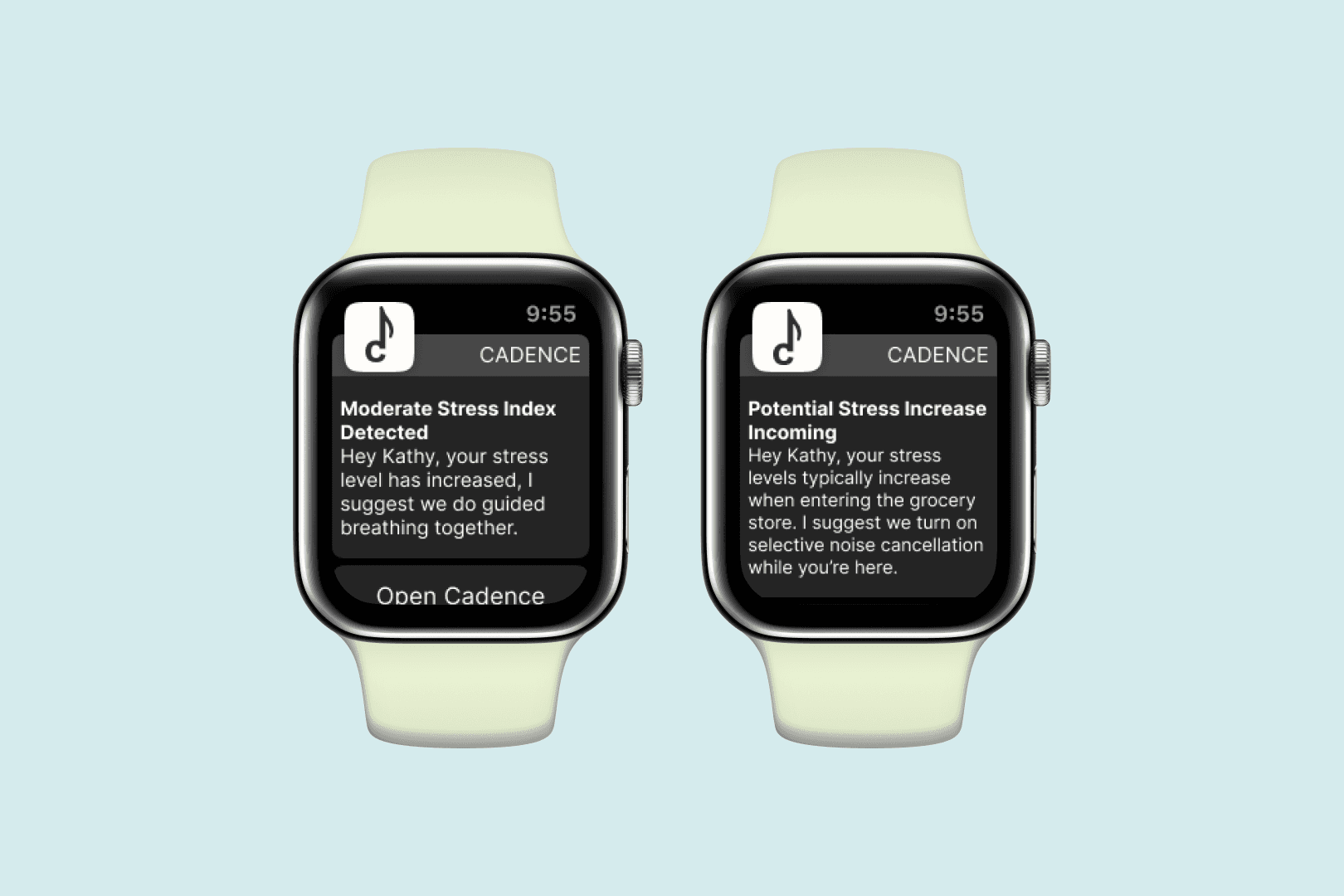
Scenario: User allows Cadence AI to track metrics through fitness wearables, Cadence Patch, smartphone, and active noise cancellation headphones/earbuds. User doesn’t log health symptoms often, as they have no chronic health conditions. Cadence AI analyzes tracked metrics and the occasional health symptom log. Cadence AI informs the user that they experience high stress while on their commute to work on the train and while in the grocery store because of the ambient noise levels. Cadence AI sends the user notifications before they enter these areas, prompting them to turn on selective noise cancellation. The user turns on selective noise cancellation, and they experience a better commute and shopping experience. User becomes more aware of what triggers stress for them.